
Background and motivation:
Optical wireless integrated sensing and communication (O-ISAC) is a promising technology for future indoor wireless networks, offering spectrum efficiency, high spatial resolution, and inherent physical-layer security. By reusing the same optical waveform and hardware, O-ISAC systems can jointly support high-rate data transmission and environmental sensing. However, sensing performance is strongly limited by receiver sensitivity, especially in low-power or long-range scenarios involving weak reflections from passive targets.
Goals of the thesis:
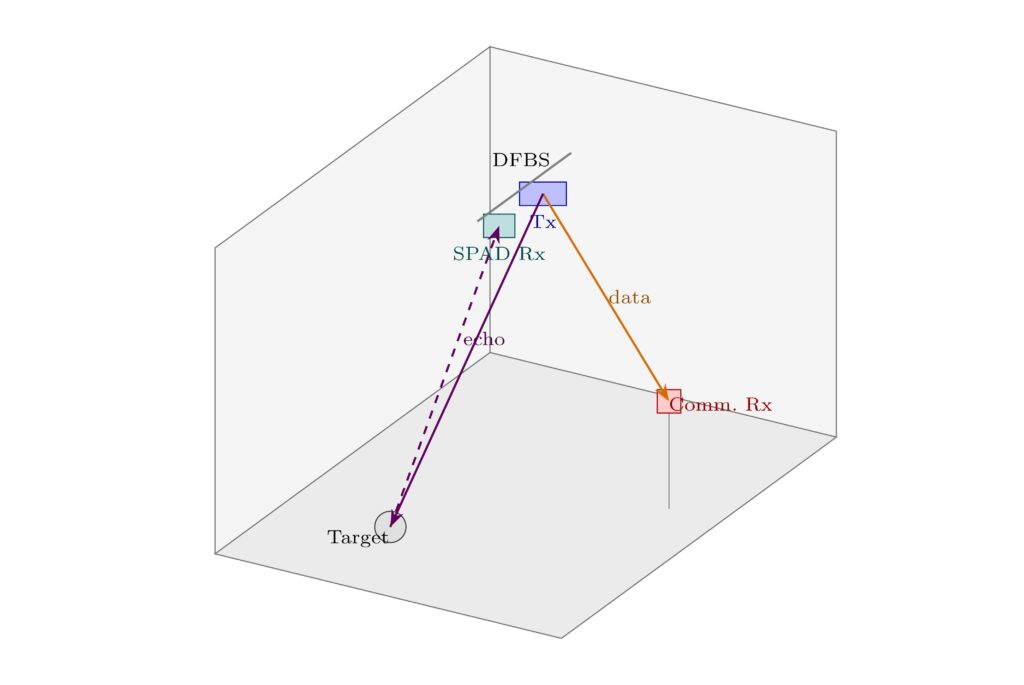
This master’s thesis investigates an O-ISAC system employing a single-photon avalanche diode (SPAD) array receiver at a dual-function base station (DFBS) to enhance sensitivity and enable reliable detection of faint reflected signals. Operating in the Geiger mode, SPAD arrays provide single-photon sensitivity and high timing resolution, making them well suited for low signal-to-noise-ratio optical sensing and communication. Their photon-counting capability allows operation close to the quantum detection limit, which is particularly advantageous for passive sensing. The considered system uses direct-current-biased optical OFDM (DCO-OFDM) under intensity modulation and direct detection (IM/DD), enabling simultaneous downlink communication and monostatic sensing with a shared waveform. Building on a waveform-level analysis of O-ISAC, this thesis studies how a SPAD-array receiver at the DFBS affects sensing and communication performance, with emphasis on range estimation, ambiguity function characteristics, and robustness at low received optical power. SPAD-specific effects such as dead time, shot-noise-dominated reception, and array-level photon counting are explicitly accounted for.
Guidelines:
- Conduct a comprehensive literature review on optical wireless ISAC and SPAD-array receivers
- Develop a system model for an O-ISAC DFBS equipped with a SPAD-array sensing receiver
- Analyze the sensing performance with emphasis on range estimation and ambiguity function characteristics under photon-counting reception
- Incorporate SPAD-specific effects, such as dead time and signal-dependent shot noise, into the performance analysis
- Investigate design trade-offs and provide guidelines for high-sensitivity O-ISAC system design
The complete project description can be found here. If you are interested in pursuing this thesis, please contact Dr. Vasileios Papanikolaou (vasilis.papanikolaou@fau.de).