
Background and motivation:
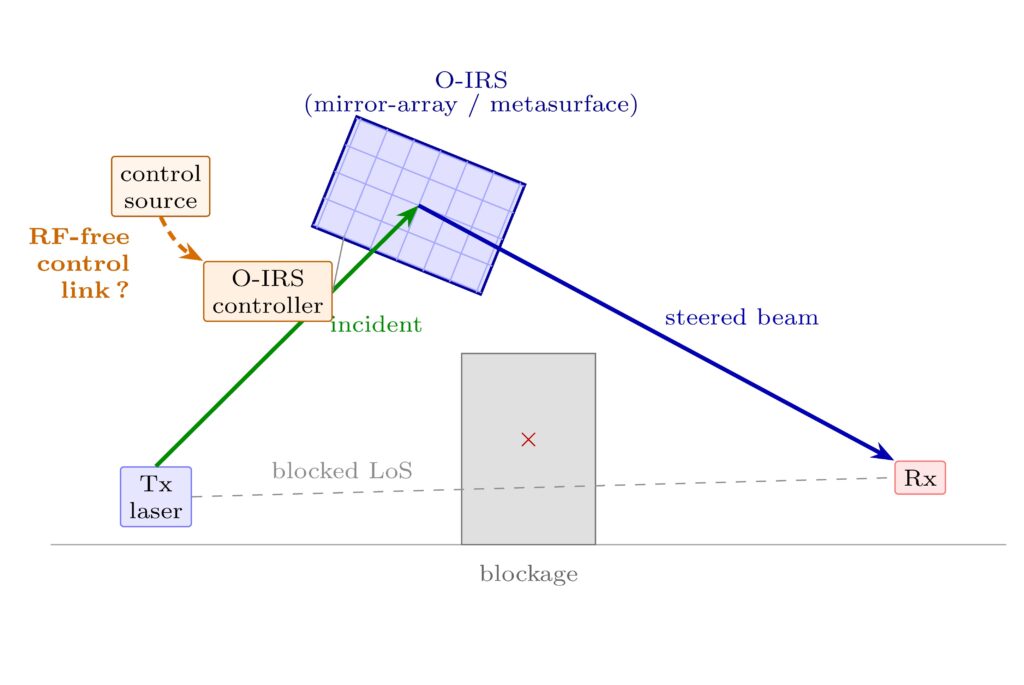
Intelligent reflecting surfaces (IRSs) have emerged as a key enabler for programmable wireless propagation environments. Their optical counterpart, the optical IRS (O-IRS), is realized either as an array of micro-mirrors or as an engineered metasurface, and is tailored to operate on optical rather than radio-frequency (RF) waves. By imposing a controlled phase structure on the incident wavefront prior to reflection, an O-IRS can redirect a highly directive free-space optical (FSO) beam toward a desired receiver and, beyond simple steering, perform operations such as beam focusing, splitting, or general wavefront shaping. This makes the O-IRS particularly attractive for directive FSO links, such as high-capacity wireless backhaul, where the strict line-of-sight requirement and narrow beam divergence make blockage a critical limitation.
Unlike its RF counterpart, an O-IRS is a fundamentally distinct hardware structure, so a dedicated modeling approach is required. In addition, it is physically separated from both the transmitter and the receiver, and must therefore be continuously configured: its mirror orientations or metasurface phase gradients have to be updated whenever the link geometry or beam alignment changes. Driving the surface thus requires a control loop, in which the O-IRS controller is told how to configure itself and reports its state back to the link. The control signaling that this loop entails, namely estimating the channel, computing the configuration, and conveying it to the surface over a control channel, introduces a non-negligible overhead that grows with the number of reconfigurable elements.
Goals of the thesis:
The seemingly natural solution of a dedicated RF control channel is, however, at odds with the very motivation for moving to the optical domain, namely offloading and relieving the congested RF spectrum. This thesis therefore investigates RF-free realizations of this control loop for the O-IRS, exploring how the configuration and feedback information needed to drive the surface can be delivered through optical or self-sustaining means; for example, a low-rate optical beacon link, local photodetector-based self-sensing, or autonomous self-aligning surfaces; and the resulting trade-offs in reconfiguration latency, overhead, accuracy, and energy.
Guidelines:
- Conduct a literature review on O-IRS (mirror-array and metasurface) and their role in FSO/optical wireless systems
- Survey and classify candidate RF-free control and signaling strategies for the O-IRS
- Develop a system model that jointly captures the Tx-O-IRS-Rx link and its control/feedback loop
- Analyze the reconfiguration overhead, latency, and pointing accuracy of the proposed control scheme(s)
- Derive design guidelines and benchmark against an RF-control baseline
The complete project description can be found here. If you are interested in pursuing this thesis, please contact Dr. Vasileios Papanikolaou (vasilis.papanikolaou@fau.de).