
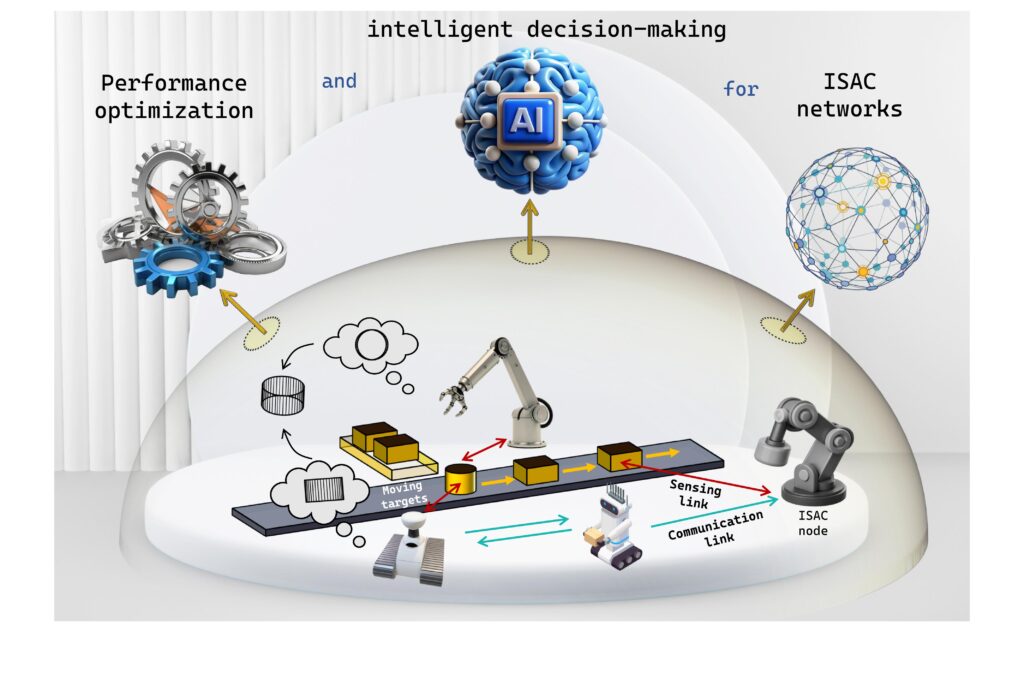
The optimization of traditional cellular communication networks has been extensively studied to maximize data throughput, reduce interference, and achieve ubiquitous wireless coverage. With the emergence of integrated sensing and communication (ISAC) as a key enabling technology for 5G-Advanced (5G-A) and sixth-generation (6G) wireless systems, next-generation networks are expected to evolve toward dual-functional platforms. While most existing ISAC works primarily focus on classical closed-loop radar-based sensing, future ISAC networks are shifting toward cognitive radars that intelligently adapt to the dynamic surrounding environment (e.g., user locations, target activities, varying blockages, and dynamic radio maps). To this end, cognitive radars employ a perception-action cycle that continuously adapts transmission strategies, beamforming policies, resource allocation, and coverage patterns according to the surrounding environment. Interesting application examples include automotive systems such as vehicle-to-everything, telemedicine, 6G wireless networks, and Industry 5.0 as illustrated in Figure 1. While a limited number of works have investigated the optimization of cognitive ISAC single-node systems, the optimization of cognitive ISAC networks remains largely underexplored.
The guidelines for this project can be summarized as follows:
- Conduct a targeted literature review on ISAC networks, cognitive radars, reinforcement learning, and mathematical optimization methods.
- Select and investigate at least one of the optimization problems mentioned here.
- Develop and implement an online optimization framework for the considered problem.
- Evaluate and compare the proposed solution against well-known benchmark schemes.
The complete project description can be found here. If you are interested in pursuing this project, please contact Amine Lahmeri (amine.lahmeri@fau.de).