
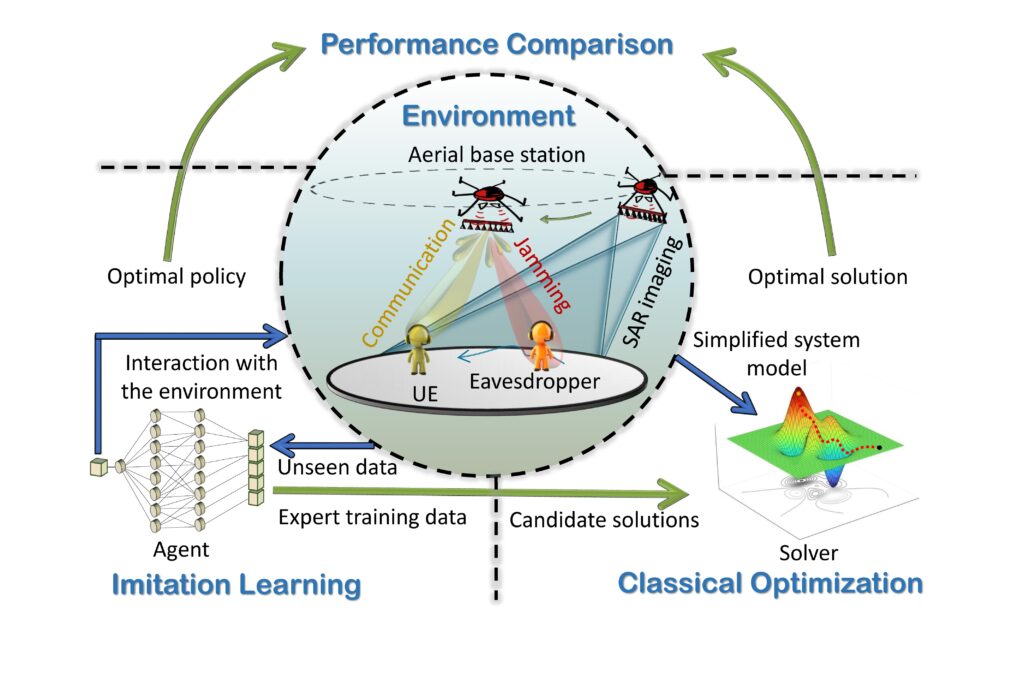
Radar imaging, particularly synthetic aperture radar (SAR), can improve wireless communication performance and security by enabling high-precision environmental awareness (e.g., tracking of ground-moving eavesdroppers in critical scenarios, such as surveillance or post-disaster communication). Ensuring secure wireless communication requires the knowledge of the eavesdropper’s channel state information (CSI), which is difficult to obtain in practice. Most existing works either assume perfect CSI or employ prior position estimates to model the uncertainty in the eavesdropper’s location.
Recently, in [1], a time-division joint SAR and communication (JSARC) framework was proposed, where an aerial base station alternates between SAR sensing and wireless communication phases. In this framework, SAR sensing is exploited to estimate the eavesdropper CSI, which is then used to intelligently adapt communication strategies in real time in order to enhance the communication secrecy rate. Building on the work in [1], this project aims to further the performance of secure JSARC systems by exploring machine learning-based optimization approaches, with a particular focus on imitation learning. More specifically, the project investigates a framework in which a learning agent is trained using expert demonstrations generated by a classical optimization solver, see Figure 1. The trained agent subsequently interacts with the environment and learns to generalize to previously unseen dynamic scenarios.
The project objectives can be summarized as follows:
- Study and implement optimization techniques for secure time-division JSARC systems.
- Design and implement an imitation learning framework for the real-time optimization of the considered problem.
- Compare the proposed method with the reinforcement learning solution presented in [1].
The complete project description can be found here. If you are interested in this project, please contact Amine Lahmeri (amine.lahmeri@fau.de).
[1] M.-A. Lahmeri, A. Khalili, Y. Liu, A. Schmeink, and R. Schober, “Deep reinforcement learning for cognitive time-division joint SAR and secure communications,” 2026, submitted to IEEE Glob. Commun. Conf.