
Background
Traditionally, the wireless communication channel has been considered an uncontrollable entity in a communication system. While transmitters and receivers can be optimized, the propagation environment itself is usually assumed to be fixed and cannot be directly influenced.
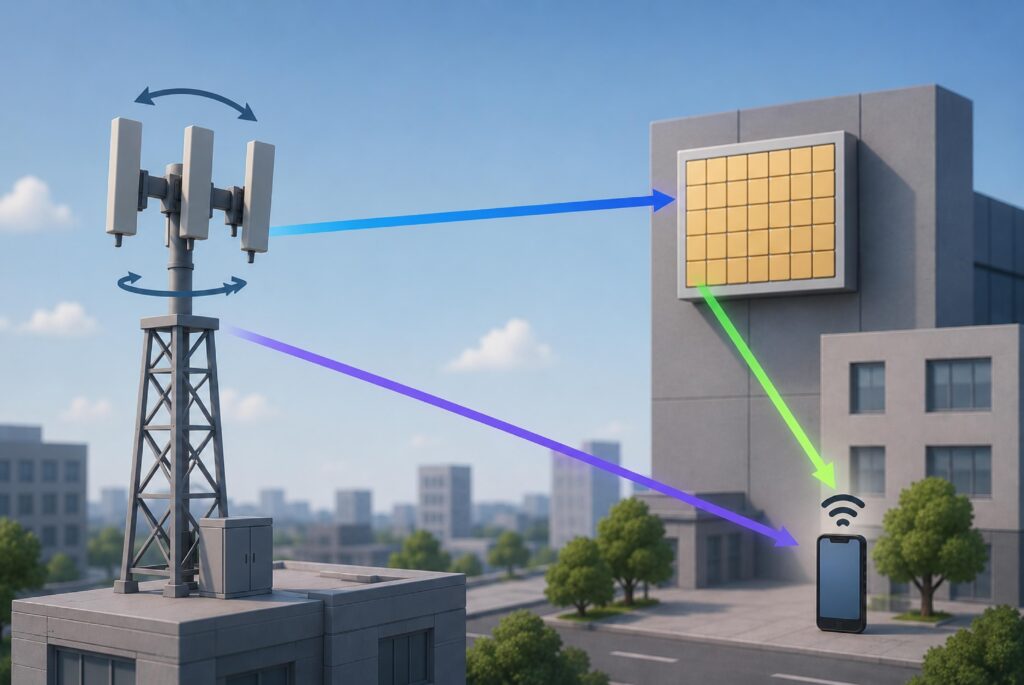
Recent research paradigms such as Intelligent Reflecting Surfaces (IRSs) and Movable Antennas (MAs) fundamentally challenge this assumption. Both technologies introduce new possibilities to actively shape and optimize the wireless propagation environment, giving rise to many new communication applications and research directions.
IRSs are nearly passive reflecting structures that manipulate incoming electromagnetic waves in a desired manner. Through their large number of reflecting elements, IRS introduce additional spatial degrees of freedom into wireless systems. This enables applications such as coverage extension, interference mitigation, improved energy efficiency, and communication secrecy.
MAs provide another novel degree of freedom by allowing antenna positions to adapt dynamically to the environment. Instead of using fixed antenna locations, MAs can be repositioned to exploit favorable channel conditions. Example applications include moving a single antenna toward positions with high received power due to interference, increasing beamforming flexibility, or adapting an antenna array such that interference toward other users is minimized.
The goal of this thesis is to develop a visualization framework for wireless communication scenarios involving IRSs and MAs. The focus lies on intuitive graphical representations and 3D simulations that illustrate how these technologies influence wireless propagation and communi- cation performance.
Guidelines for the project:
- Literature survey on IRSs and MAs
- Implementation of communication simulation
- Visualization concept and selection of software
- Visualization of the communication systems
Prerequisites:
- Basic programming skills
- Basic knowledge of mobile communication systems (e.g. gained in the course “Nachrichtentechnische Systeme” and ”Introduction to Communication Systems”).
The complete project description can be found here. If you are interested in pursuing this thesis, please contact Moritz Garkisch (moritz.garkisch@fau.de).