
Abstract:
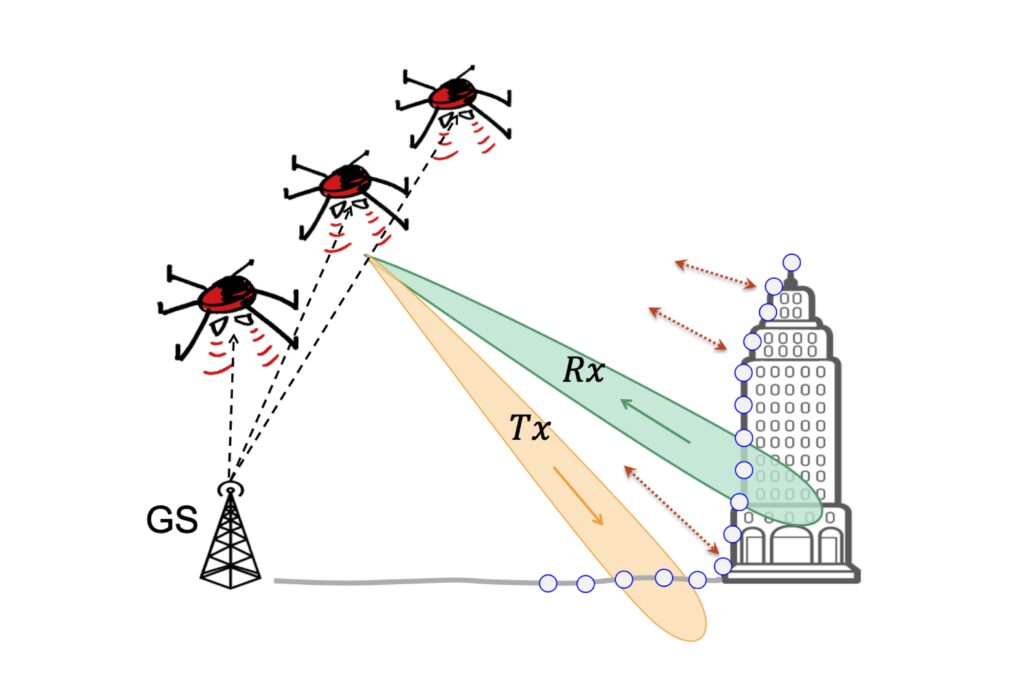
The deployment of unmanned aerial vehicle (UAV) swarms for remote sensing has attracted significant attention in recent years. Multiple-input multiple-output (MIMO) synthetic aperture radar (SAR) tomography leverages multiple transmit (Tx) and receive (Rx) channels to generate three-dimensional (3D) radar images. In contrast to conventional repeat-pass tomography, it enables the discrimination between single- and multiple-bounce scattering mechanisms. However, achieving effective transmit and receive beamforming requires the careful design of the UAV formation. Furthermore, to alleviate computational complexity, the acquired radar data is offloaded in real time to a ground station (GS) via a communication backhaul link.
This thesis investigates the joint resource allocation and formation optimization of a UAV-based MIMO-SAR tomography system. In particular, it focuses on the design of transmit and receive beams with desired characteristics, such as controlled mainlobe width and reduced sidelobe levels.
Guidelines for the project:
- Conduct a targeted literature review.
- Develop an appropriate system model and identify the relevant degrees of freedom.
- Formulate an optimization framework to minimize sidelobe levels of the Tx and Rx beams under communication and sensing quality-of-service constraints.
- Propose an efficient solution to the formulated problem.
- Evaluate and compare the performance of the proposed approach with classical benchmark schemes.
Prerequisites:
- Interest in communications and sensing.
- Basic knowledge of convex optimization.
- Experience in programming languages (Python and/or Matlab).
- English fluency
A summary of the thesis proposal can be found here. If you are interested in pursuing this thesis, please contact
Pouya Fakharizadeh (pouya.fakharizadeh@fau.de).