Master Thesis/Bachelor Thesis/Research Project — Particle Propagation in Pipes with Spatially Restricted Absorbing Areas
Background:
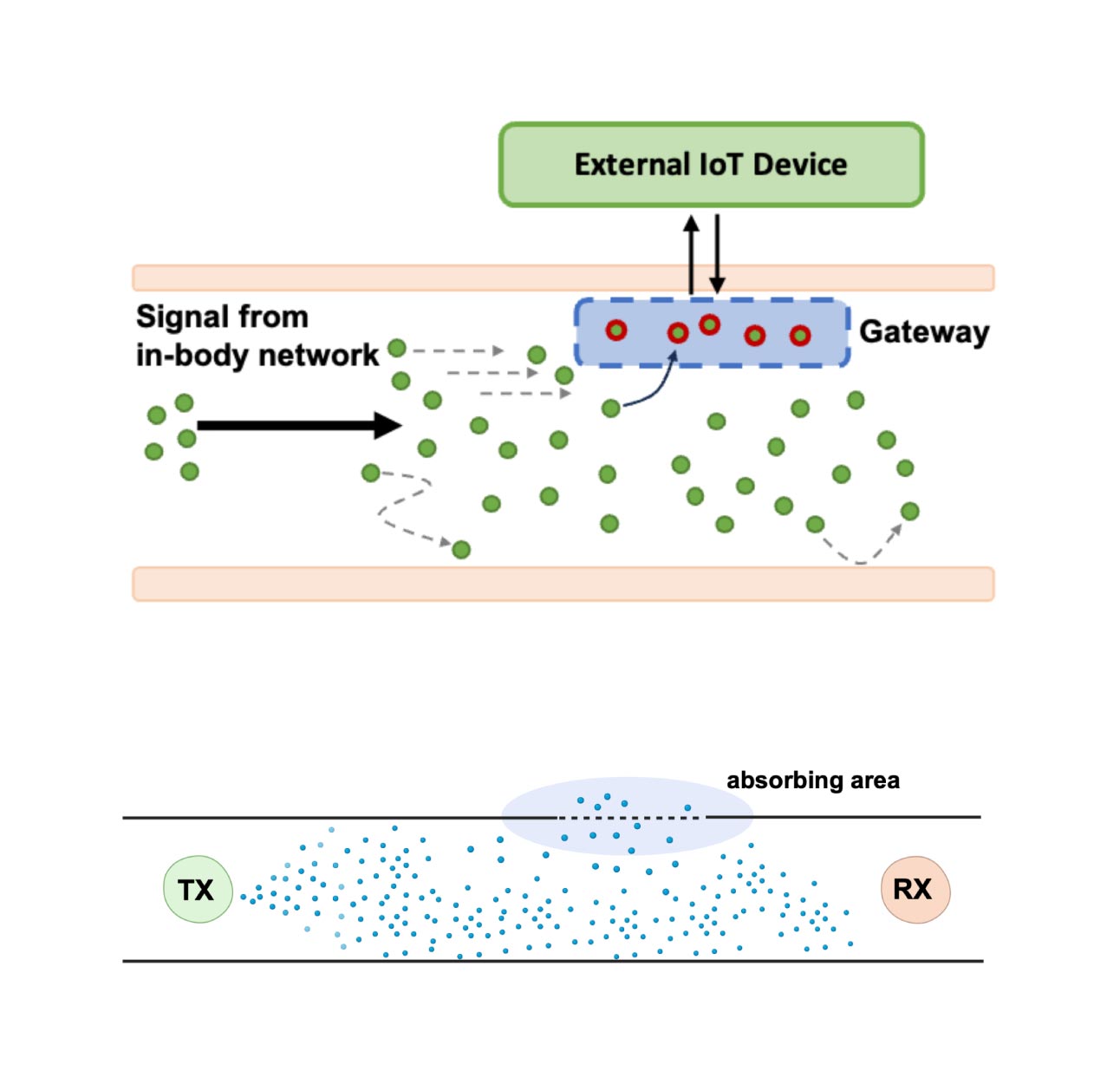
Molecular Communication (MC) is an emerging communication paradigm which uses molecules to convey information. MC applies communication engineering principles to bio-medical applications such as targeted drug delivery, health monitoring, and micro-fluidic channel design. In the future, in-body devices are expected to communicate with each other by means of MC and are connected to the Internet to form the Internet of BioNanoThings (IoBNT). In contrast to existing Internet of Things (IoT) devices for external health monitoring, IoBNT devices form an in-body communication network that enables localized diagnosis and personalized treatment on the organ or even single cell level. One of the major challenges towards the realization of the IoBNT is the development of interfaces capable of transforming a molecular signal into a macroscopic signal (see upper part of Fig. 1). Those gateways are mostly based on the (temporarily) binding of signaling molecules causing a reaction or emission of a macroscopic signal that can be detected externally (e.g., light, magnetism, back-scattering behaviour).
Interpreting the system in Fig. 1 from a more general perspective, any gateway based on the binding or catching of molecules can be interpreted as an absorbing area in the channel boundary (see lower part of Fig. 1). Considering an MC system as shown on the right hand side of Fig. 1, there are two main research questions:
- How does the presence of absorbing areas in the channel boundary affect the spatio-temporal distribution of molecules and the impulse response of a MC system?
- In the case of a gateway, how many molecules are absorbed and how can I optimize the absorption process?
For the first research question, the goal of a MC system design is to optimize the impulse response between a transmitter (TX) and a receiver (RX) while the “negative” effect of the absorbing area should be minimized. For the second research question, the design goal is to optimize the number of molecules absorbed by area.
Project Objectives:
The goal of this master thesis is to develop analytical and numerical communication-theoretical models for the MC system shown in Fig. 1. The developed models should contain the effects of diffusion, (laminar) flow and possible degradation reactions inside the channel. Moreover, the models should take the effect of multiple absorbing areas in the channel boundary and their effect on the particle propagation into account. The main objectives of this master thesis are as follows:
- Literature review on diffusion and flow systems with sectional boundary conditions and identification of use-cases for the envisioned communication-theoretical models.
- Development of a (semi)-analytical model for the spatio-temporal particle concentration in a circular disk, with sectional boundary conditions, i.e., only specific regions of the boundary are absorbing, while the other parts are fully reflective.
- The models developed for diffusion in a circular disk shall be extended by a flow component. Therefore, the circular disk is spatially extended to a pipe by adding a 𝑧-component. In a first step, plug flow is considered as an idealized flow profile. If possible, the models shall be extended to a laminar flow profile.
- The models shall be exploited to analyze the influence of a single and multiple absorbing areas on the impulse response and the spatial concentration profile of a simple TX- RX arrangement. Moreover, the models shall be used to investigate and optimize the characteristics of the absorbing areas (e.g., number of absorbed molecules, etc.).
- A numerical or particle-based simulation model shall be derived. These simulation models serve as a proof-of-concept first and later for the validation and refinement of the obtained analytical models.
A full description of the project can be found here. Depending on the type of project (Bachelor Thesis/Research Project/Master Thesis), the scope can be adjusted. In case you are interested in pursuing this project, please contact Dr.-Ing. Maximilian Schäfer (max.schaefer@fau.de) or Timo Jakumeit (timo.jakumeit@fau.de).